
Penang wedding traditions
Chinese and Peranakan wedding terms, explained
The words you are likely to hear at a Chinese or Peranakan (Baba-Nyonya) wedding, in the order they come up: from choosing the date to the twelfth day. Each term links the source it comes from, and where sources disagree, we show both.
Looking for one word? Use the list of terms below. For the story of each wedding, read our guides to the Chinese wedding and the Peranakan wedding.
In Penang, the Peranakan Chinese are more often called Baba Nyonya: the words began as family titles for the sons and daughters of Peranakan parents, says Malaysia's National Department for Culture and Arts. Source: Malaysia's National Department for Culture and Arts: Penang Peranakan customs
Where these terms come from
- Penang: Penang Global Tourism, the state's tourism agency, which publishes wedding guides for Penang.
- Malaysia: the National Department for Culture and Arts, whose cultural map has an entry on Penang's Peranakan customs.
- Singapore: the National Heritage Board, its Peranakan Museum and the National Library Board. They describe weddings in Singapore, so each card says which place its source speaks for.
- Hong Kong: the Chinese University of Hong Kong's Cantonese dictionary, for how a word is read.
Customs differ between dialect groups and between families, says the National Heritage Board, and a wedding planner it interviewed tells couples to ask their families first. Source: Singapore's National Heritage Board: Chinese Weddings
Choosing the date
Some families pick the day by the almanac or a fortune teller, and some avoid one month altogether.
- Tongshu通书
- The Chinese almanac: a fortune-telling calendar that marks auspicious days and times. Some people still use it to choose dates for weddings, and families use it to pick an auspicious day for the betrothal.
- Sources: Singapore's National Heritage Board: Chinese almanac (Tong Shu) print; Singapore's National Library Board: Chinese weddings
- Fortune teller's slip
- Advice a fortune teller writes out for a couple. It uses their dates and times of birth to work out how compatible they are, gives the auspicious date and time for each ceremony, and can even name people to avoid on the wedding day.
- Source: Singapore's National Heritage Board: fortune teller's slip for a wedding couple
- Seventh month七月
- The seventh month of the lunar calendar, when Zhong Yuan Jie (中元节), the Hungry Ghost Festival, is observed. Not getting married during the month is one of the superstitions around it.
- Source: Singapore's National Heritage Board: Zhong Yuan Jie (Hungry Ghost Festival)
The proposal and the betrothal
Before the wedding, the two families agree the terms and exchange gifts.

- Proposing ceremony
- The first formal step. A representative visits the bride's family, and her mother agrees the dowry, the number of banquet tables and the most suitable day. The groom's side doesn't bargain, so as not to lose dignity. The engagement follows once both families agree.
- Source: Malaysia's National Department for Culture and Arts: Chinese engagement customs
- Guo da li过大礼
- The betrothal. The groom, with a female relative, brings gifts to the bride's family on an auspicious day before the wedding. Items are chosen for their symbolism, such as mandarin oranges for luck.
- Sources: Singapore's National Heritage Board: Chinese Weddings; Singapore's National Library Board: Chinese weddings
- Pin jin
- The bride price, given in a red packet at the betrothal to honour the bride's parents. The bride's family usually keeps a token sum and returns the rest, so it doesn't look as if they are selling their daughter.
- Source: Singapore's National Library Board: Chinese weddings
- Hui li回礼
- The gifts the bride's family hands back at the betrothal, to show they accept the marriage.
- Source: Singapore's National Heritage Board: Chinese Weddings
- Jia zhuang嫁妝
- The bride's trousseau, which she receives at the betrothal.
- Source: Singapore's National Heritage Board: Chinese Weddings
- Mei po媒婆
- A professional matchmaker. Wedding planners and specialist shops now do much of the advising a mei po once did.
- Source: Singapore's National Heritage Board: Chinese Weddings
- Lap chai
- The gift exchange that seals the engagement. The groom's family arrives with decorated gift trays, and the bride's family returns half as many.
- Sources: Penang Global Tourism: Peranakan wedding guide; Singapore's National Heritage Board: Peranakan wedding basket
- Bakul siah
- A four-tiered basket used through the twelve-day wedding, to carry the lap chai gifts and the bowls of kueh ih sent with invitations.
- Source: Singapore's National Heritage Board: Peranakan wedding basket
The days and the night before
Invitations go out, the bed is blessed and, on the eve, the couple's hair is combed.
- An chuang安床
- Setting up the marriage bed, three days to a week before the wedding: new bed linen and a red tray of items for prosperity. On the day, a young boy jumps and rolls on the bed to wish the couple children.
- Source: Singapore's National Heritage Board: Chinese Weddings
- Double happiness
- The motif that decorates the bridal bed, with red bedsheets, for an auspicious start to married life. Penang Global Tourism's guide adds pomegranates on the bed, for fertility.
- Source: Penang Global Tourism: Chinese wedding guide
- Lau tia meh
- The wedding eve. The couple bathe in water with pomelo leaves, change into new pyjamas and slippers, and have their hair brushed by a parent. They celebrate apart, because seeing each other that night is bad luck.
- Source: Penang Global Tourism: Chinese wedding guide
- Shang tou上头
- The hair-combing ritual the night before the wedding, marking the move into adulthood. Hair is combed four times, with a blessing each time. It was traditionally Cantonese; other dialect groups in Singapore now practise it too.
- Sources: Singapore's National Heritage Board: Chinese Weddings; Singapore's National Library Board: Chinese weddings
- Sang ih
- The sixth day before the wedding, when relatives receive a formal invitation with small red and white glutinous rice balls in syrup.
- Source: Singapore's National Heritage Board: Peranakan wedding basket
- Pak chindek
- The master of ceremonies, who led the party delivering the invitations.
- Source: Singapore's National Heritage Board: Peranakan wedding basket
- Khui tiah
- A ritual like a bridal shower, held separately by each of the couple after the lap chai.
- Source: Penang Global Tourism: Peranakan wedding guide
- Sang jit
- The flour-pounding ceremony two days before the wedding, when close family gather to make traditional cakes such as onde-onde, pineapple tarts and kuih genggang.
- Source: Malaysia's National Department for Culture and Arts: Penang Peranakan customs
- An chng
- Blessing the wedding bed. A comb of bananas, lemongrass and yam, with three lit joss sticks, went in an earthen pot under the bed, and a young boy rolled across it three times.
- Source: Peranakan Museum, Singapore: An Chng, blessing the wedding bed
The wedding day
Fetching the bride, the tea ceremony that joins the families, and what the couple wear.
- Red veil
- On the wedding morning, the bride's parents or relatives place a red veil over her head, to drive away evil spirits, and she waits for the groom. He lifts it once he is let into her room.
- Source: Penang Global Tourism: Chinese wedding guide
- Heng tai
- The groomsmen, who go with the groom to fetch the bride and face the bridesmaids at her door. The word matches the Cantonese reading of 兄弟, "brothers" (hing1 dai6).
- Sources: Penang Global Tourism: Chinese wedding guide; Chinese University of Hong Kong: Cantonese reading of 兄; Chinese University of Hong Kong: Cantonese reading of 弟
- Ji mui
- The bridesmaids, who guard the bride's door and set the groom his challenges. The word matches the Cantonese reading of 姊妹, "sisters" (zi2 mui6). Singapore's National Library Board writes it jie mei.
- Sources: Penang Global Tourism: Chinese wedding guide; Singapore's National Library Board: Chinese weddings; Chinese University of Hong Kong: Cantonese reading of 姊; Chinese University of Hong Kong: Cantonese reading of 妹
- Door boy
- The bride's representative who opens the car door for the groom when his convoy of cars arrives, horns sounding.
- Source: Penang Global Tourism: Chinese wedding guide
- Gatecrashing
- The bridesmaids set the groom and his groomsmen a series of playful tasks before he can see the bride. The groomsmen then give each bridesmaid a red packet, and the bridesmaids may bargain for more. Teochew families hold it very early, because the bride should leave home before sunrise.
- Sources: Singapore's National Heritage Board: Chinese Weddings; Penang Global Tourism: Chinese wedding guide
- Hongbao
- A red packet of money. The groom's side hands them over to get past the door, the bride's side often asks for a sum with nines in it, and elders give them to the couple at the tea ceremony.
- Source: Singapore's National Library Board: Chinese weddings
- Red umbrella
- Held over the bride to shelter her as she leaves her home.
- Source: Singapore's National Heritage Board: Chinese Weddings
- Lady Fan
- A red folding fan the bride throws out of the bridal car's window as she sets off, to leave negative things behind.
- Source: Singapore's National Heritage Board: Chinese Weddings
- Tea ceremony
- The couple serve tea to their elders and receive red packets or gold jewellery and blessings in return. It marks the bride's acceptance into the groom's family and respect for the elders. One is held at the groom's home, where the couple may first pray at the family altar, and a separate one for the bride's family. In Penang, says the state tourism guide, the couple kneel and call each relative by their Chinese title.
- Sources: Singapore's National Heritage Board: Chinese Weddings; Singapore's National Heritage Board: a Chinese wedding tea ceremony; Penang Global Tourism: Chinese wedding guide
- Qun kua裙褂
- The bride's red two-piece wedding outfit, embroidered with phoenixes and flowers, often worn for the tea ceremony. Red stands for good fortune and happiness.
- Sources: Singapore's National Heritage Board: Chinese Weddings; Penang Global Tourism: Chinese wedding guide
- Kua褂
- A traditional red Chinese wedding dress embroidered with auspicious symbols. The bride changes into it before the tea ceremony for her own family.
- Source: Singapore's National Heritage Board: Chinese Weddings
- Ma kua马褂
- The groom's traditional outfit, which some couples keep for rituals such as the tea ceremony.
- Source: Singapore's National Heritage Board: Chinese Weddings
- Tang suit
- The groom's traditional outfit in Penang Global Tourism's guide, worn with the bride's qun kua: red and gold, often with dragons and phoenixes for a harmonious marriage.
- Source: Penang Global Tourism: Chinese wedding guide
- Cheo thau
- The hair-combing ceremony on the wedding day, marking the move from childhood to adulthood. The hair is combed four times: for marital harmony, a resilient marriage, children and an unbroken family line, and mutual respect. Parents then dress the couple.
- Source: Penang Global Tourism: Peranakan wedding guide
- Chim pang
- The couple's first meeting: the bride leads the groom into her bridal chamber and he lifts her veil. They share a bowl of kueh ee, their first meal as husband and wife.
- Source: Penang Global Tourism: Peranakan wedding guide
- Kueh ee
- Small red and white glutinous rice balls in a sweet syrup, for a sweet beginning. Eaten at the chim pang and sent to relatives with the invitations.
- Sources: Penang Global Tourism: Peranakan wedding guide; Singapore's National Heritage Board: Peranakan wedding basket
- Tuang teh
- The tea ceremony. The "tea" is not Chinese tea but red dates (ang choe), dried longans and rock sugar, boiled together. The couple serve it to elders by seniority and receive red packets or gold.
- Source: Penang Global Tourism: Peranakan wedding guide
- Mak andam
- The traditional wedding consultant. A symbolic toll gate and a pantun (verse) duel, set up by the mak andam, sometimes stand between the groom and his bride on the dais.
- Source: Malaysia's National Department for Culture and Arts: Penang Peranakan customs
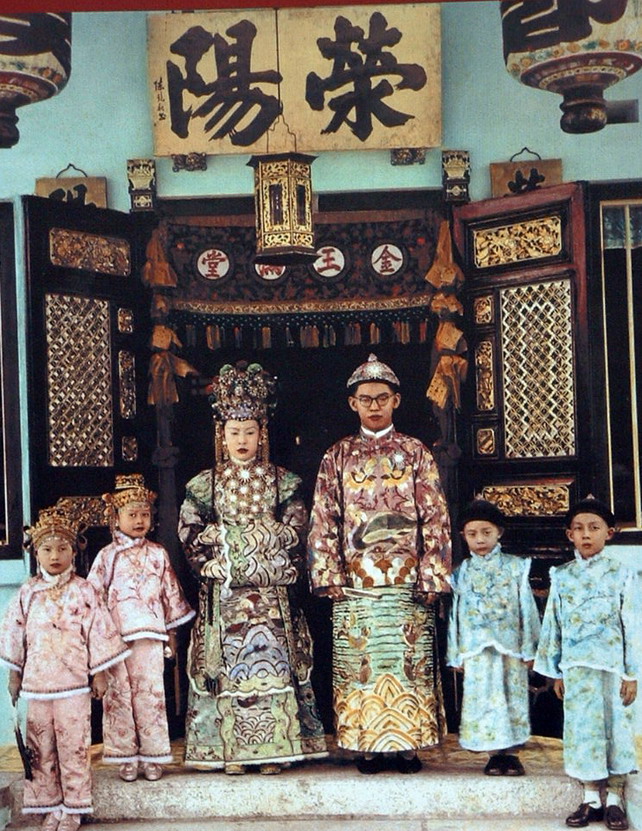
- Kuah or baju panjang
- The bride's two-piece costume, embroidered with peonies, cranes, mandarin ducks and phoenixes, worn with a chandelier necklace and as many as 144 hairpins.
- Sources: Penang Global Tourism: Peranakan wedding guide; Singapore's National Heritage Board: Peranakan wedding outfit
- Pak kuah
- A small mirror set in the middle of the long tassel on the bride's coloured braid, to deflect evil.
- Source: Singapore's National Heritage Board: Peranakan Chinese wedding couple
- Baju lokchuan
- The groom's short Manchu-style jacket over a longer gown, embroidered with the same motifs and worn with a brocade Mandarin cap.
- Source: Penang Global Tourism: Peranakan wedding guide
- Tng sah beh kua
- The groom's short jacket, worn over a long Chinese gown, in a National Heritage Board collection note.
- Source: Singapore's National Heritage Board: Peranakan Chinese wedding couple
- Hwa boh
- The groom's Mandarin cap.
- Source: Singapore's National Heritage Board: Peranakan Chinese wedding couple
The banquet
The evening celebration: the toast, the long table, and the music and dances.
- Yam seng
- The banquet toast. Guests shout "yam seng" ("cheers") three times, as loudly as they can, to bless the couple.
- Source: Singapore's National Heritage Board: Chinese Weddings
- Lion dance
- Banquet entertainment believed to ward off evil spirits and bless the occasion. The lions go round the room and guests "feed" them red packets, so have some ready.
- Source: Penang Global Tourism: Chinese wedding guide
- T'ng tok
- "Long table": the banquet, served in sets along long rectangular tables. It was once held before the wedding; many couples now make it the wedding banquet.
- Source: Penang Global Tourism: Peranakan wedding guide
- Bunga rampai
- A potpourri of thinly sliced flowers and pandan leaves, scattered down the aisle by flower girls in Nyonya kebaya.
- Source: Penang Global Tourism: Peranakan wedding guide
- Kebaya Nyonya
- The Nyonya's short kebaya, worn with batik in animal and floral motifs. Flower girls and women guests wear it at the t'ng tok.
- Sources: Malaysia's National Department for Culture and Arts: Penang Peranakan customs; Penang Global Tourism: Peranakan wedding guide
- Dondang sayang
- A traditional Malay art of music, songs and pantun (verse), with violins, gongs and tambourines. A common entertainment at Peranakan weddings.
- Sources: Penang Global Tourism: Peranakan wedding guide; Malaysia's National Department for Culture and Arts: Penang Peranakan customs
- Joget lambak
- A social dance guests are invited to join at the wedding, along with fan, handkerchief, bowl and orange dances.
- Source: Malaysia's National Department for Culture and Arts: Penang Peranakan customs
After the wedding day
A traditional Peranakan wedding ran for twelve days. These terms belong to the days that followed.
- Sohja tiga hari
- The third day of the twelve-day wedding, the day a National Heritage Board note gives for the tea ceremony.
- Source: Singapore's National Heritage Board: Peranakan marriage certificate
- Bridal basin
- A large wash basin the bride's father gave as a wedding gift. It stood in the bridal room, and the bride used it to serve warm water to her husband while the couple stayed at her home during the twelve-day wedding.
- Source: Singapore's National Heritage Board: Peranakan wedding basin
- Bibi nasi lemak
- The cook chosen to make the nasi lemak, a must on the twelfth and last day of the celebrations.
- Source: Malaysia's National Department for Culture and Arts: Penang Peranakan customs
- Che umm
- As the public celebrations end on the twelfth day, the newlyweds share this formal meal with their in-laws, marking the start of a new family.
- Source: Malaysia's National Department for Culture and Arts: Penang Peranakan customs
Where the sources differ
We don't pick a winner. Here is what each source says.
When the betrothal happens
Singapore's National Library Board says one to two weeks before the wedding; its National Heritage Board says two to four weeks. Both say the day is chosen for being auspicious.
Sources: Singapore's National Library Board: Chinese weddings; Singapore's National Heritage Board: Chinese Weddings
The bridesmaids' name
Penang Global Tourism writes ji mui and glosses it as bridesmaids. The National Library Board writes jie mei and translates it as "sisters".
Sources: Penang Global Tourism: Chinese wedding guide; Singapore's National Library Board: Chinese weddings
The bed ritual
The National Heritage Board's Chinese weddings entry calls it an chuang (安床). The Peranakan Museum spells the Peranakan version an chng.
Sources: Singapore's National Heritage Board: Chinese Weddings; Peranakan Museum, Singapore: An Chng, blessing the wedding bed
Which tea ceremony comes first
The National Heritage Board's Chinese weddings entry puts the bride's family's tea ceremony after the groom's. A note in its collection says it is done either before or after.
Sources: Singapore's National Heritage Board: Chinese Weddings; Singapore's National Heritage Board: a Chinese wedding tea ceremony
The groom's outfit
Penang Global Tourism's guide dresses the groom in a tang suit. The National Heritage Board names the ma kua (马褂).
Sources: Penang Global Tourism: Chinese wedding guide; Singapore's National Heritage Board: Chinese Weddings
Kueh ee or kueh ih
Penang Global Tourism spells the rice balls kueh ee. The National Heritage Board spells them kueh ih.
Sources: Penang Global Tourism: Peranakan wedding guide; Singapore's National Heritage Board: Peranakan wedding basket
When the tea ceremony happens
Penang Global Tourism puts the tuang teh on the wedding day, straight after the chim pang. A National Heritage Board collection note places it on the third day (sohja tiga hari) of the twelve.
Sources: Penang Global Tourism: Peranakan wedding guide; Singapore's National Heritage Board: Peranakan marriage certificate
How long the wedding lasted
Penang Global Tourism says weddings once ran up to a month, then fifteen days, then twelve. The National Heritage Board describes them as lasting up to twelve days. Malaysia's National Department for Culture and Arts says twelve days, with less affluent families celebrating only the first and the twelfth.
Sources: Penang Global Tourism: Peranakan wedding guide; Singapore's National Heritage Board: Peranakan marriage certificate; Malaysia's National Department for Culture and Arts: Penang Peranakan customs
Sang ih or sang jit
The National Heritage Board calls the sixth day before the wedding sang ih, when relatives receive invitations with kueh ih. Malaysia's National Department for Culture and Arts describes the invitations with kueh ih, lanterns and red cloth hung at the door six days before, and a sang jit two days before: the flour-pounding ceremony.
Sources: Singapore's National Heritage Board: Peranakan wedding basket; Malaysia's National Department for Culture and Arts: Penang Peranakan customs
Who the pak chindek is
The National Heritage Board calls the pak chindek the master of ceremonies, leading a party of five. Malaysia's National Department for Culture and Arts says the task falls to the eldest uncle, in traditional Chinese dress.
Sources: Singapore's National Heritage Board: Peranakan wedding basket; Malaysia's National Department for Culture and Arts: Penang Peranakan customs
What the chim pang is
Penang Global Tourism describes it on the wedding day: the bride leads the groom into her chamber, he lifts her veil and they share kueh ee. Malaysia's National Department for Culture and Arts calls it their formal meeting before the wedding day, with candles lit by both families and the couple seated facing each other.
Sources: Penang Global Tourism: Peranakan wedding guide; Malaysia's National Department for Culture and Arts: Penang Peranakan customs
The groom's jacket
Penang Global Tourism calls it the baju lokchuan. A National Heritage Board collection note calls it the tng sah beh kua.
Sources: Penang Global Tourism: Peranakan wedding guide; Singapore's National Heritage Board: Peranakan Chinese wedding couple
Common questions
- What does heng tai mean at a Chinese wedding?
- Heng tai are the groomsmen, who go with the groom to fetch the bride and face the bridesmaids (ji mui) at her door, as Penang Global Tourism's wedding guide describes it. The word matches the Cantonese reading of 兄弟, which means brothers.
- What is guo da li?
- Guo da li (过大礼) is the betrothal: the groom, with a female relative, brings gifts to the bride's family on an auspicious day before the wedding, and her family hands some back (hui li) to show they accept the marriage. Singapore's National Heritage Board puts it two to four weeks before the wedding; its National Library Board says one to two weeks.
- What happens at a Chinese tea ceremony?
- The couple serve tea to their elders and receive red packets or gold jewellery and blessings in return. Singapore's National Heritage Board says it marks the bride's acceptance into the groom's family and respect for the elders, and that one is held at the groom's home and a separate one for the bride's family. Penang Global Tourism's guide says the couple kneel and call each relative by their Chinese title.
- How do families choose an auspicious wedding date?
- Some still use the Chinese almanac, the tongshu (通书), which marks auspicious days and times. A fortune teller may also write the couple a slip that works out their compatibility from their dates and times of birth and gives the auspicious date and time for each ceremony. Malaysia's National Department for Culture and Arts says Penang Peranakan families also use feng shui and fortune-telling to choose the date.
- Do Chinese couples avoid getting married in the seventh month?
- Some do. Singapore's National Heritage Board lists not getting married during the seventh lunar month, the month of Zhong Yuan Jie or the Hungry Ghost Festival, among the superstitions around it. Ask both families whether they keep it before you fix a date.
- What is the Peranakan tea ceremony called?
- Tuang teh. Penang Global Tourism's guide says the Peranakan "tea" is not Chinese tea but red dates (ang choe), dried longans and rock sugar, boiled together, served to elders by seniority.
Sources read on 4 October 2026. Singapore's National Library Board article did not open for us that day, so the entries that cite it stand as we read them on 26 September 2026.
Planning a Chinese or Peranakan wedding?
Find a venue with room for the tea ceremony and the banquet. Send us your date and we check it directly with the venue.